
By: Haidi Wu, IBE Research Assistant
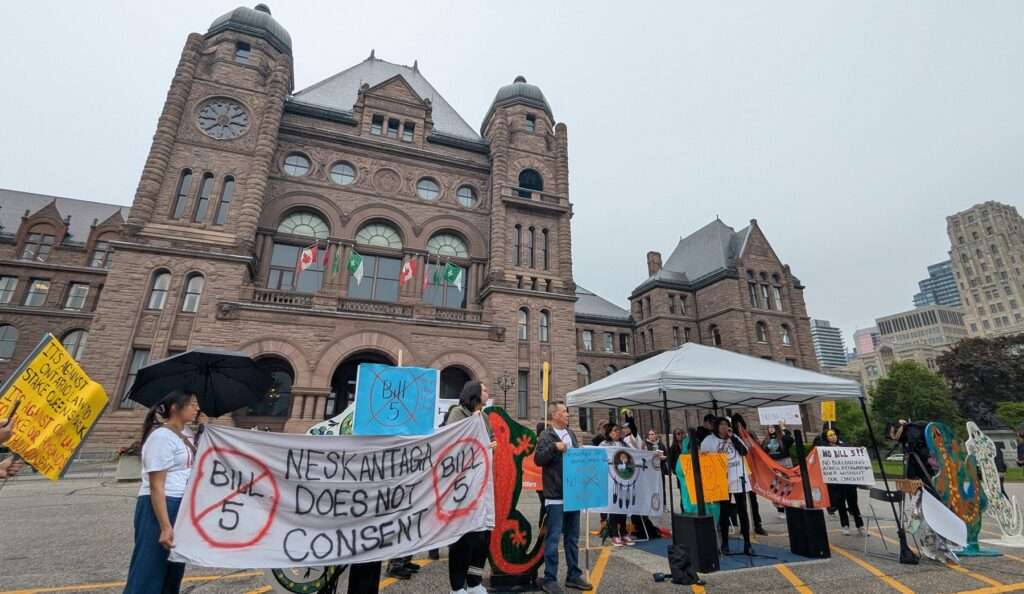
On May 28, 2025, First Nations representatives, progressive MPPs, and environmental advocates gathered in front of Queen’s Park to protest Bill 5, the Protect Ontario by Unleashing our Economy Act. As a new member of the Infrastructure Beyond Extractivism (IBE) team, I was there to support our collaborators from Neskantaga First Nation.
Bill 5, now passed, weakens environmental protections and circumvents Indigenous rights and consultation in the name of fast-tracking development. Among those who came to voice their concerns were some of the leadership, youth, and elders from Neskantaga, which is a small Anishinaabe community living on a reserve 560 km north of Thunder Bay on Treaty No. 9 lands. Neskantaga opposes potential mining development in the Ring of Fire region and fears their laws and lifeways may be permanently affected by Bill 5.
What is Bill 5?
Bill 5 fast-tracks mining (and other types of development) by allowing the provincial cabinet to create lawless special economic zones and exempt “trusted proponents” or projects from any municipal or provincial laws. The bill also repeals the Endangered Species Act, replacing it with the Species Conservation Act—a hollowed-out statute that narrows the definition of “habitat,” allows cabinet to de-list species, and drastically weakens protections. Bill 5’s amendments to the Heritage Act allows cabinet to hand out exemptions to requirements for archaeological assessments, which paves the way for projects to potentially bulldoze First Nations burial grounds. Finally, it has canceled the environmental assessment for the Eagle’s Nest nickel mine proposed by Wyloo Metals (a privately-held Australian company) in the Ring of Fire.
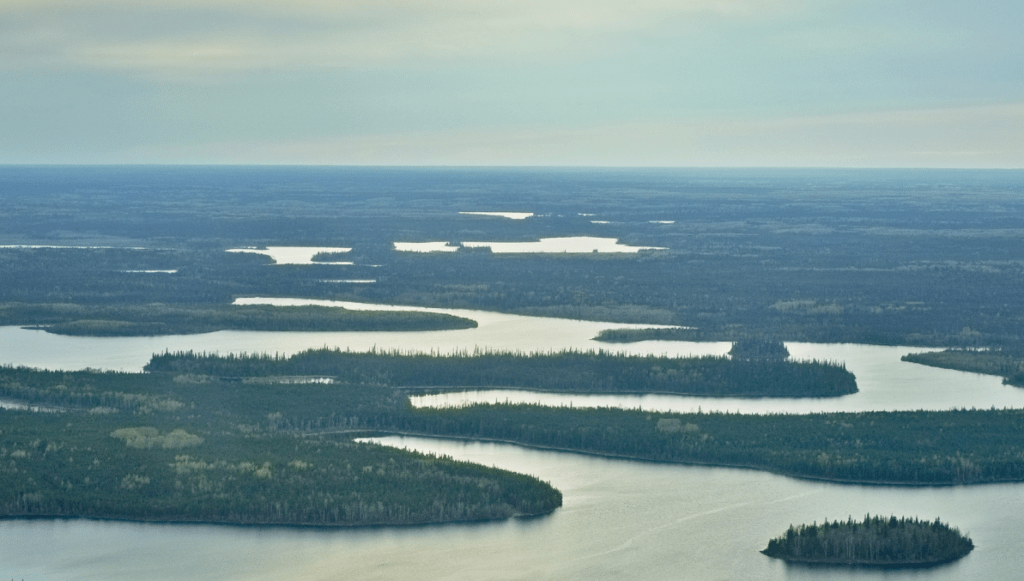
As we heard from Indigenous leaders during two days of committee hearings, this bill will accelerate projects that sacrifice First Nations’ rights for the sake of economic benefits touted by Ontario. For years, Neskantaga has strongly opposed Doug Ford’s plans to open the Ring of Fire for mining without their free, prior, and informed consent. The Ring of Fire is a mineral deposit situated within a vast boreal peatlands ecosystem known to First Nations in the region as the Breathing Lands. The Breathing Lands play a crucial ecological role in storing fresh water and carbon. With Bill 5, however, the Ring of Fire is set to be the first special economic zone in the province. Bill 5 and proposed mining in the Ring threaten habitats for species such as the ecologically sensitive sturgeon, which are currently listed as a species of Special Concern. It will also threaten cultural sites.
Beyond the immediate impacts on natural and cultural heritage, Bill 5 represents a power-grab that elevates the decisions of the party in power above evidence-based environmental regulation and the inherent jurisdiction of Indigenous peoples. In their written submission presented at the Bill 5 committee hearings, Neskantaga called it “a blatant attempt by Ontario to avoid its duty to consult and accommodate Neskantaga First Nation and other affected First Nations in the Ring of Fire area” and “an attempt to overwrite Ontario’s obligations flowing from Treaty No. 9” (p. 1):
Our understanding of Treaty No. 9 is that we entered into a legal relationship with the Crown based on principles of friendship, mutual respect, and shared arrangements. In exchange for our promise to keep peaceful relations, the Crown promised to protect both our livelihoods and our jurisdiction over the land as times changed. We did not cede, sell, or surrender our homelands, nor did we give up our inherent rights or jurisdiction by entering into the Treaty. […] Because of the importance of our lands, our obligation to protect them, and the Crown’s promise to respect our jurisdiction, any decisions affecting our homelands and way of life must go through our authority. — p. 2-3 of Neskantaga’s written submission to Ontario’s Standing Committee on the Interior, May 26, 2025
Neskantaga’s submission raised a broad range of concerns ranging from the impacts of cancelling the environmental assessment for Eagle’s Nest and the Crown’s constitutional duty to consult and accommodate, to the unconstitutionality of special economic zones, and the implications of the bill for sturgeon and cultural sites. The message was clear: “there will be no ‘constitution-free zones’ in Ontario” (p. 6). What’s more, “the only way to avoid ‘red tape’ when it comes to extracting resources on [Neskantaga’s] lands is to fully obtain [their] Free, Prior, and Informed Consent.” (p. 10).
Rally at Queen’s Park on May 28, 2025
After participating in committee hearings the previous day, Neskantaga voiced their staunch opposition outside Queen’s Park. To them, the bill is an escalation of the Ford government’s attempts to trespass on the Breathing Lands, in its persistent support for building mining roads that would cross the Attawapiskat river (which Neskantanga has stewarded for generations). We heard from women, elders, and community members such as Sharon Sakanee, who came to protect the land for her grandson and for future generations. “That’s where we get our food and medicine—from the land,” she said. “I continue to use that river system to hunt and fish with my grandson. And I tell him that this is where my family grew up—at the Attawapiskat river—where my father was born and his parents were born,” she shared before leading chants of “No to Bill 5. No Ring of Fire.”
Former Chief Wayne Moonias also spoke. “Our community, our elders have said that they are willing to go down and protect… their river system—the lifeline, the Breathing Lands of our people—not just for today, but for generations. Generations before us and generations to come. That’s why we’re here today. That’s why our grassroots people are here today.”
“No bulldozing will be done by premier Ford or any other drivers that’re gonna cross the river system of Attawapiskat Lake.” —Wayne Moonias, Former Chief of Neskantaga
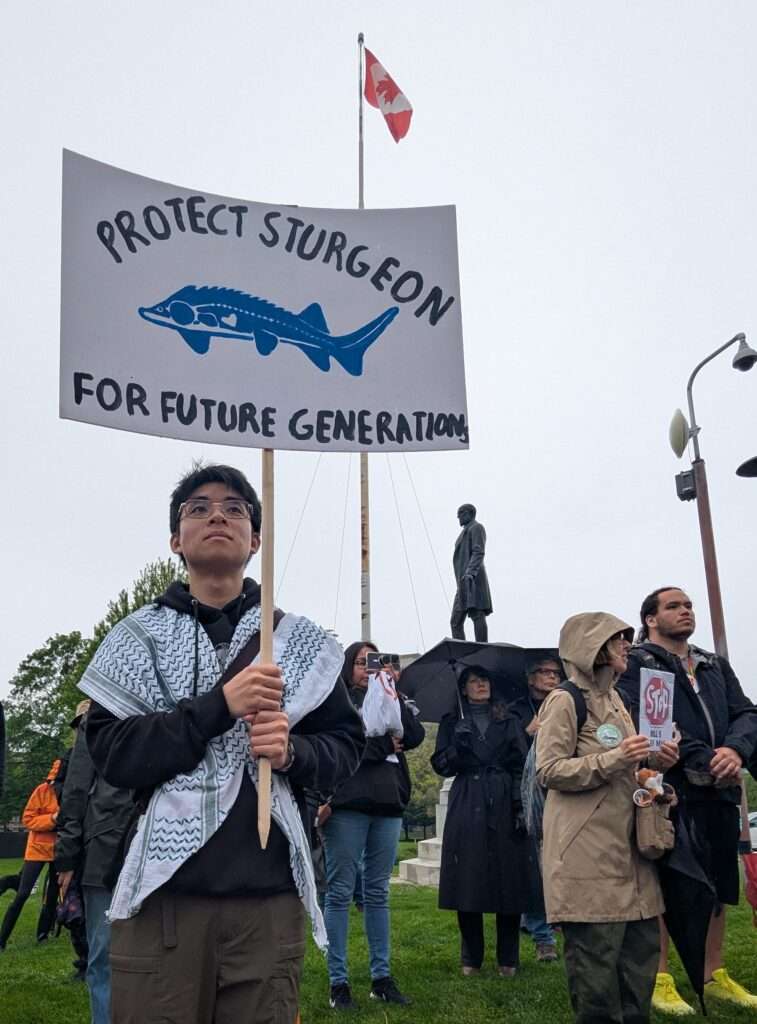
They were joined by environmental lawyers and advocates, progressive MPPS, Indigenous people, wildlife biologists, and youth who expressed concern for a shared future with birds, bees, and butterflies. Many viewed this bill as an attack on evidence-based environmental regulation. “We need a government that’s governed by science, not politics,” said Green Party MPP Mike Schreiner in reference to the repeal of the Endangered Species Act and the replacement of science-based biodiversity protection with increased ministerial discretion. Groups also raised alarms over the undemocratic nature of powers granted to the provincial cabinet by special economic zones provisions, which EcoJustice criticized as “dictatorial.” Adding to these concerns is the way this bill has been rammed through despite the public outcry—the conservative government passed the contentious bill after using a time allocation motion to limit debate time to one hour prior to voting.
What comes next?
The conservative government announced that it would add provisions for Indigenous consultation to the Bill as well as for the creation of special “Indigenous-led economic zones.” They also promised to consult First Nations before designating the Ring of Fire a special economic zone. Meanwhile, First Nations leaders have questioned why they were not at the table during the initial drafting of the bill and have called for it to be withdrawn.
Despite moves by Liberal and NDP MPPs to filibuster and delay its passing, Bill 5 passed on Wednesday, June 5, 2025. The updated bill is missing the promised amendments for Indigenous consultation. One thing we heard from speakers at the rally was that the struggle does not end with the passing of Bill 5. The provincial and federal governments will continue their attempts to assert jurisdiction over stolen Indigenous lands, and Nations including Neskantaga will continue to resist. When they do, we must support them by showing up to their rallies, pressuring our representatives in the Legislature, informing our friends about the legal challenges they are sure to put forward, and monetarily (e.g., through donating to legal funds such as the Raven Trust). First Nations leaders have indicated that the bill could elicit a response reminiscent of the 2012 Idle No More movement. When the call to action comes from First Nations on the front lines, will you be ready to show up?
Haidi Wu is a Research Assistant on the IBE project. Haidi is an incoming student in the Master in Environmental Studies (MES) program at York University, beginning September 2025.