
Events
Thursday, June 4, 2026, 6:30 to 8:00 p.m.
Jurisdiction Back: Reclaiming Indigenous Jurisdiction Through an Ethic of Care
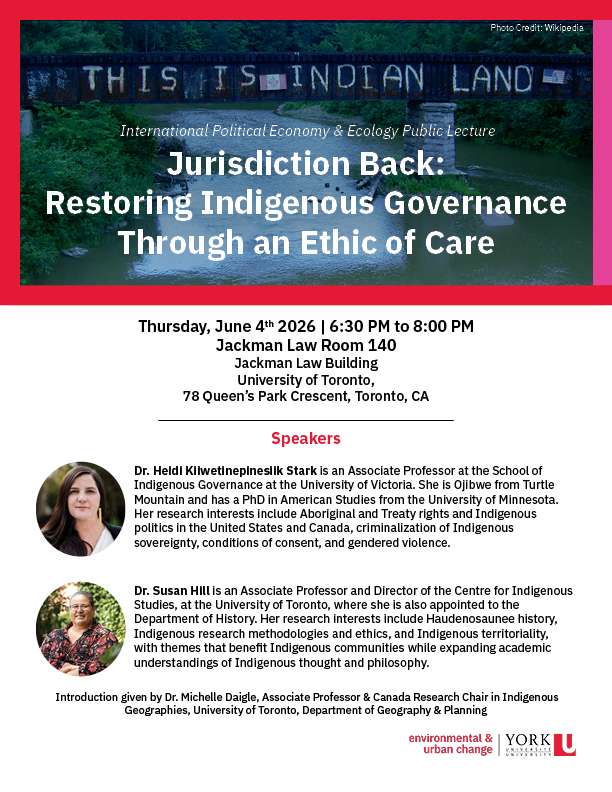
This event was a public lecture, part of the 2026 International Political Economy and Ecology (IPEE) Summer School held at York University, June 1-9, 2026. The 2026 IPEE course was titled, “Jurisdiction Back: Restoring Indigenous Governance in the Wake of Extraction,” which you can learn more about here.
Dr. Heidi Kiiwetinepinesiik Stark is an Associate Professor at the School of Indigenous Governance at the University of Victoria. She is Ojibwe from Turtle Mountain and has a PhD in American Studies from the University of Minnesota. Her research interests include Aboriginal and Treaty rights and Indigenous politics in the United States and Canada, criminalization of Indigenous sovereignty, conditions of consent, and gendered violence. She is the co-editor of Indigenous Resurgence in an Age of Reconciliation, with Aimée Craft and Hokulani K. Aikau, as well as Centering Anishinaabeg Studies: Understanding the World Through Stories with Jill Doerfler and Niigaanwewidam Sinclair, She is also the co-author of the third edition of American Indian Politics and the American Political System with Dr. David E. Wilkins. Dr. Stark’s research background includes collaborative work with Indigenous communities in the United States and Canada.
Dr. Susan Hill is an Associate Professor and Director of the Centre for Indigenous Studies, at the University of Toronto, where she is also appointed to the Department of History. Her research interests include Haudenosaunee history, Indigenous research methodologies and ethics, and Indigenous territoriality, with themes that benefit Indigenous communities while expanding academic understandings of Indigenous thought and philosophy. She is particularly interested in Haudenosaunee knowledge and thought, seeking to make sense of contemporary lives through an examination of how people got to where they are now, both literally and figuratively. She is the author of The Clay We Are Made Of: Haudenosaunee land tenure on the Grand River, published by the University of Manitoba Press (2017).
Introduction given by Dr. Michelle Daigle, Associate Professor and Canada Research Chair in Indigenous Geographies, University of Toronto, Department of Geography and Planning.
Thursday, March 5, 2026
Student Research Symposium: What’s Actually Happening in the Ring of Fire?
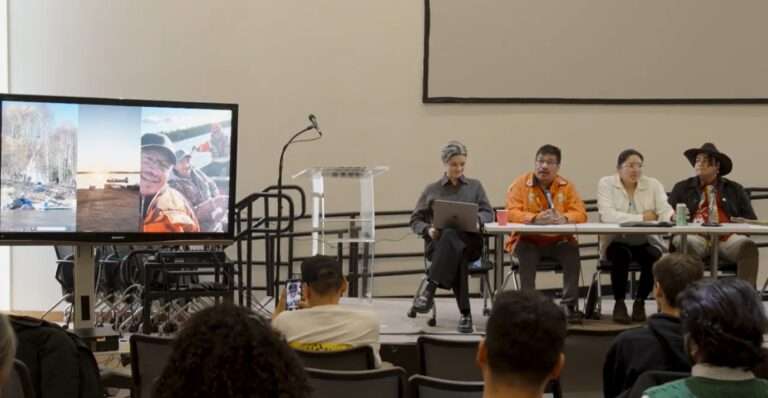
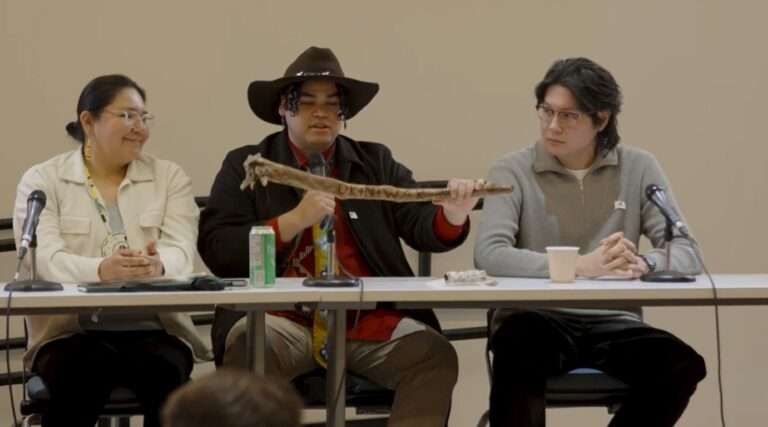
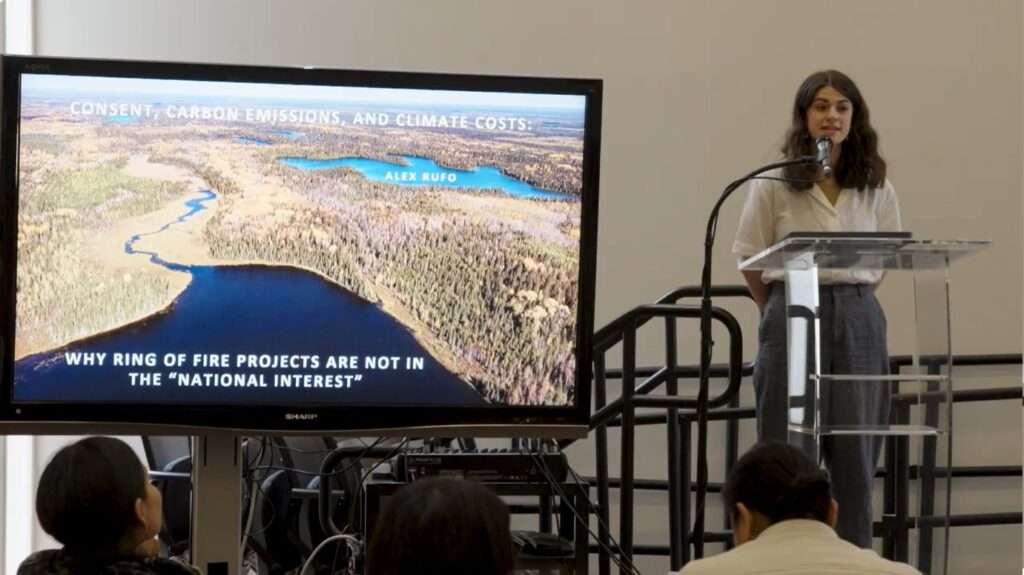
On March 5, 2026, the Environmental Justice and Sustainability Clinic at Osgoode Hall Law School hosted a student research symposium, “What’s Actually Happening in the Ring of Fire?” This event brought together law students and land defenders from Neskantaga First Nation, Attawapiskat First Nation, and 8th Fire Rising to make sense of the rapidly changing regulatory landscape across the Indigenous homelands of Treaty No. 9. Leaders, land defenders, and community members from Neskantaga First Nation and Attawapiskat First Nation described the Here We Stand camp they have set up on the Attawapiskat River (at the proposed crossing site for the mining road) and their ongoing land defence actions.
To learn more about student research related to the Ring of Fire region, check out this IBE Blog piece, “Major Problem for Major Projects: Why the Ring of Fire Should Stay Off the Major Project Office’s List.”
Friday, May 23, 2025, 3-5 p.m. EST
Reclaiming Indigenous Jurisdiction in the Climate Crisis: Critical Analyses of ‘Critical’ Infrastructure
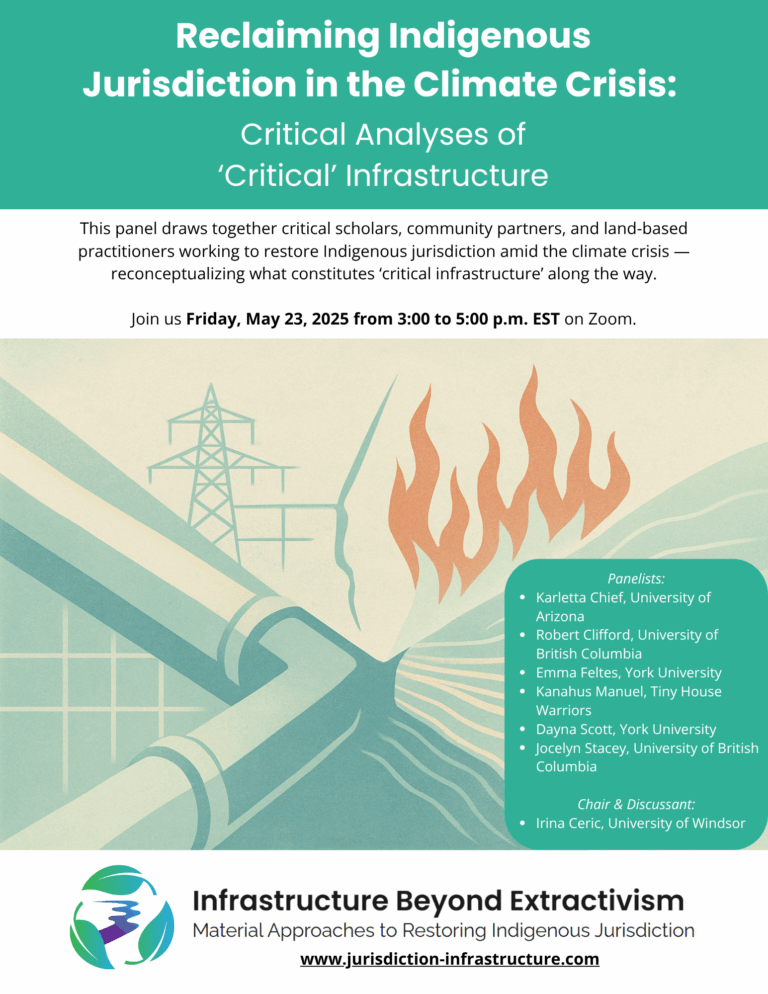
This panel draws together critical scholars from law, geography, and anthropology with community partners and land-based practitioners who are working to restore Indigenous jurisdiction in the context of the climate crisis — and are reconceptualizing what constitutes ‘critical infrastructure’ along the way. From standing against pipeline projects, to revitalizing Indigenous systems of land and fire stewardship, to fighting for a radically ‘just transition’ panelists will speak across a diversity of strategies for reclaiming jurisdictional authority and remaking the material and socio- technical infrastructures that sustain collective life on Indigenous lands. But, in addition to material infrastructure, panelists will also explore whether and how legal ‘infrastructures’ can be remade to foreground Indigenous authority in the transition.
This panel will include the following presentations:
- Emma Feltes (York University) and Jocelyn Stacey (Allard School of Law, University of British Columbia), “Right to Burn: Indigenous Rights and Jurisdiction in a Country on Fire”
- Kanahus Manuel (Tiny House Warriors), “Building Anti-colonial Solidarity Infrastructure Networks”
- Dayna Nadine Scott (Osgoode Hall Law School and York University), “Infrastructural (Dis)Entitlement: Coercive Dispossession on the Critical Minerals Frontier”
- Karletta Chief (University of Arizona), “A Just Transition Post-Coal Mining Plan for Black Mesa United: Navajos living within the Peabody Western Coal Company (PWCC) Leasehold Area”
- Robert Clifford (Allard School of Law, University of British Columbia), “The Jurisdictional Entanglements of LandBack”
Time and Date: Friday, May 23, 2025 from 3:00 to 5:00 p.m. EST
Location: Online (Zoom)
Register here: https://yorku.zoom.us/meeting/register/vYZJnzrET8qrSulvXZL6xQ
September 19, 2024 at 2:00 p.m.
The Mining Industry is a Chemical Industry
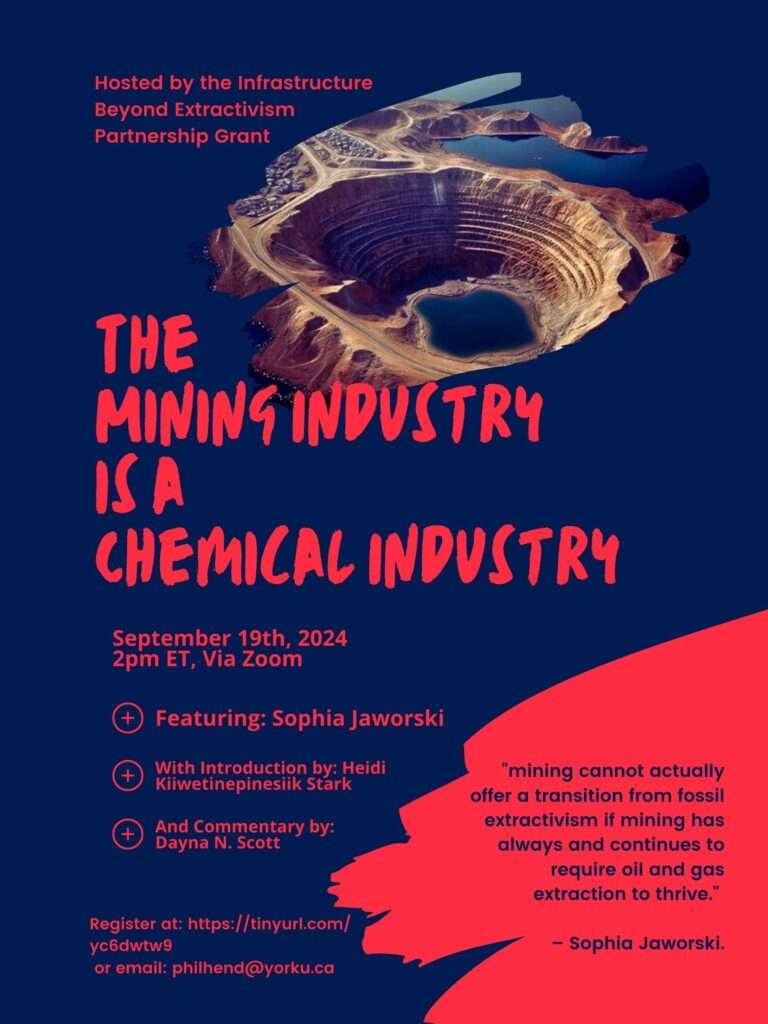
Featuring: Dr. Sophia Jaworski
With Introduction by Heidi Kiiwetinepinesiik Stark
And Commentary by Dayna Nadine Scott
Date: September 19, 2024
Time: 2:00 p.m. EST
Location: Online (Zoom)
[REGISTER HERE]
“Mining cannot actually offer a transition from fossil fuel extractivism if mining has always and continues to require oil and gas extraction to thrive.”
—Sophia Jaworski
February 15, 2024, 4-6 PM
Settler Colonial Continuities:
The Energy Transition in Indian Country

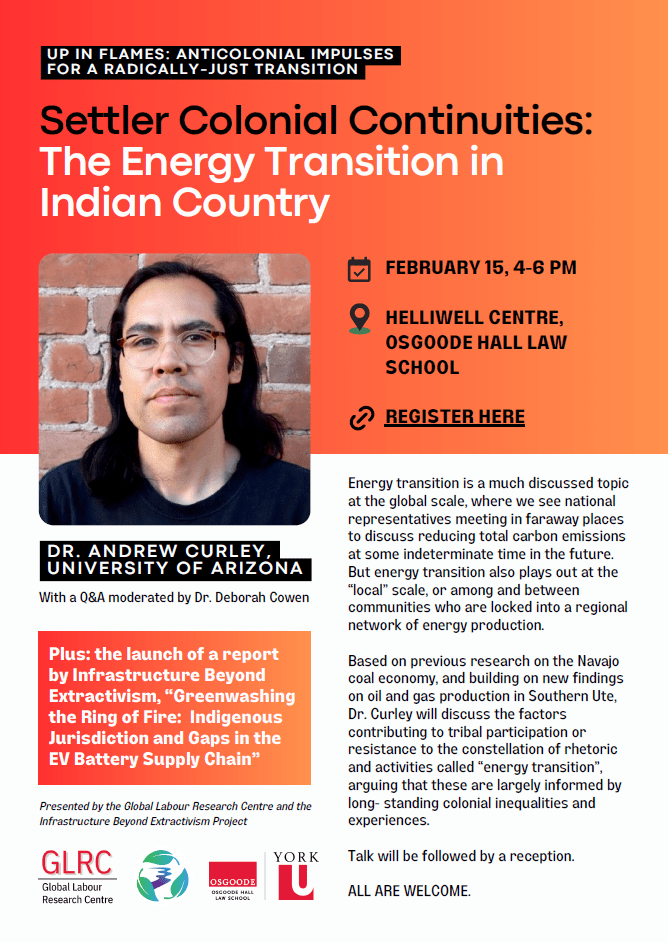
Join us for the launch of our Up in Flames series, a partnership between Infrastructure Beyond Extractivism (IBE) and the Global Labour Research Centre (GLRC) at York University.
Speaker: Dr. Andrew Curley, University of Arizona
With a Q & A moderated by Dr. Deborah Cowen
Plus: the launch of a report by Infrastructure Beyond Extractivism, “Greenwashing the Ring of Fire: Indigenous Jurisdiction and Gaps in the EV Battery Supply Chain”
Date: February 15, 2024
Time: 4:00 to 6:00 PM
Location: Helliwell Centre, Osgoode Hall Law School
[REGISTER HERE]
Energy transition is a much discussed topic at the global scale, where we see national representatives meeting in faraway places to discuss reducing total carbon emissions at some indeterminate time in the future. But energy transition also plays out at the “local” scale, or among and between communities who are locked into a regional network of energy production.
Talk will be followed by a reception.