
By: Hargun Kaur Rekhi, MES student at York University
Mining in the Ring of Fire is driven by billionaires who reap the rewards while local communities and ecosystems are plundered.
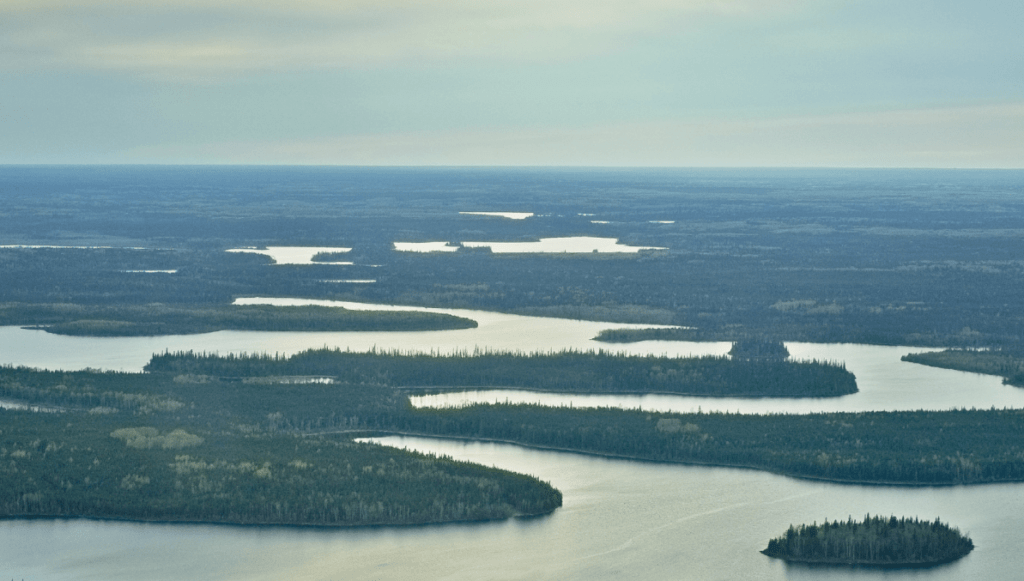
The Breathing Lands (Bakitanaamowin Aki) in the far north of Ontario hold some of the largest intact peatland ecosystems in the world, acting as an essential carbon sink for Canada. Their protection is vital for curbing the climate catastrophe and sustaining the remote Anishinaabe communities that have stewarded them since time immemorial. But our governments see only the “Ring of Fire,” a 500,000-hectare crescent-shaped deposit of minerals said to hold a wealth of critical minerals, deemed crucial for rescuing Ontario’s economy in the wake of the tariff war with the U.S. There are now over 43,000 mining claims on this land.
Ontario’s Ford government, since coming to power in 2018, has pushed to accelerate mining in the Ring of Fire, despite facing fierce Indigenous opposition. Both Ontario and Canada introduced fast-tracking legislation last year that could mean the area becomes a designated “Special Economic Zone” or a “National Interest Project” as a way to further remove regulatory obligations and subsidize mineral exploration and extraction. The critical mineral frenzy is driven by the presence of copper, nickel, and chromite deposits, whose usage can range from electric car batteries to military materials and stainless-steel production. And often these governments promise that developing these resources is important for “economic reconciliation.” But this is only half of the story.
There are two large claim holders in the Ring of Fire. Juno Corp., a Canadian company, and the Australian metals giant Wyloo have staked 26,000 and 10,600 mining claims, respectively. This gives the two companies control of 80% of the stakes in the region.
Who is Behind Juno?
Robert D. Cudney is the CEO of Juno. While sharing drinks with Noront CEO Richard Nemis and geologist John Harvey in 2007 at Cyrano, a popular bar in downtown Toronto for mining financiers, the three men created the name “Ring of Fire” for the area of minerals located in the Hudson Bay Lowlands. Over time, Cudney has amassed a fortune through investments. He has a reported net worth of $3.2 billion in 2026, a number that will likely increase if any of the Juno stakes turn into actual mines. Cudney has been working in this industry for more than 40 years. He described in an interview that his list of projects includes Gold Eagle Mine, Guyana Goldfields, Cantex Mine, Nighthawk Gold, and others; each comes coupled with its own controversies and issues.
Cudney’s companies hold clear political influence. While the public evidence for lobbying and donations is limited, some links can be established connecting Juno to the Provincial legislature. Juno Corp, formerly known as Northfield Capital, has prominent individuals on its board of directors. Among them is Ernie Eves, who served as the Ontario Minister of Finance from 1995 to 2001 and as the Ontario Premier from 2002 to 2003. He has over 20 years of experience as a Progressive Conservative MPP. He joined Northfield in 2022, shortly after the company began showing interest in the Ring of Fire, and was selected for this role based on his “experience and contacts.”
Ernie Eves has continued working in quasi-public roles after leaving elected office. His consulting firm, Natel Strategies, was paid consulting fees by Northfield Capital amounting to $60,000 over two years, as described in the company’s financial statements from 2025 and 2026. These connections indicate that a former premier was offering paid consultation to a mining firm.
There is a clear convergence of interests between Ontario’s current infrastructure strategy, public investment in the Ring of Fire, and Juno’s position as the largest mineral claim holder.
Although Juno has staked the most claims in the region, the most advanced project, the notoriously delayed Eagle’s Nest mine, is held by Wyloo, a privately-held Australian company. Canada and Ontario have both gone to extreme measures to exempt the Eagle’s Nest mine from Impact Assessments.
“Twiggy”: The Ostentatious Australian Billionaire Behind Wyloo’s Eagle’s Nest
The billionaire behind Wyloo, the 2nd-largest claim holder in the Ring of Fire and the owner of the most advanced project in the region, is Australian Andrew “Twiggy” Forrest, with an estimated net worth of $18.6 billion. Forrest, a controversial figure who has drawn the ire of environmentalists, Indigenous peoples, and fellow industrialists alike, likens himself as a green energy visionary and “lifelong friend of his Indigenous fellow countrymen in the Pilbara.” But it’s his business practices that have recently landed his company in hot water, costing millions and drawing the kind of criticism typically reserved for fictional corporate villains.
Forrest owns Australian iron-ore company Fortescue Metals Group (now Fortescue Ltd.), the mining company he founded and long-led as chief executive and later as executive chairman.
The Yindjibarndi lawsuit against Fortescue, decided in May of this year, is an Australian native title case concerning the title rights of the Yindjibarndi people affected by Fortescue’s mining operations. The case files have been released by the Australian Federal Court, and they demonstrate that Forrest played a central leadership role in the events that gave rise to the litigation.
What is the Case About?
The dispute arose after Fortescue developed its Solomon Hub iron ore mine on Yindjibarndi country without securing an Indigenous Land Use Agreement with the recognized native title body, the Yindjibarndi Aboriginal Corporation (YAC). After the courts confirmed the Yindjibarndi people’s exclusive native title rights, the Yindjibarndi Ngurra Aboriginal Corporation sought compensation for cultural and economic loss resulting from Fortescue’s mining activities. In May, the Yindjibarndi prevailed, and the Federal Court ordered Fortescue to pay approximately A$150 million for cultural loss and A$100,000 for economic loss, making it one of Australia’s largest native title compensation awards.
This compensation, however, pales in comparison to the profits Fortescue made by extracting minerals from Yindjibarndi lands. The Australian Financial Review reports that the mine produces one-third of Western Australia’s ore, and 75% of its land is part of the Yindjibarndi native title area. In 2026, the company experienced a half-year net profit of US$9 billion, and almost US$700 million of dividends will be paid to Andrew and his ex-wife Nicola Forrest, the billionaires who control 37% of Fortescue shares. As such, the amount awarded to the Yindjibarndi peoples amounts to less than 0.3% of the company’s turnover, and discharges them from future liability — meaning that Fortescue can continue its unauthorized extraction.
The entire mining empire of the Solomon Hub, with its 107-truck fleet and two ore processing facilities, was built against the objections of the Yindjibarndi people, who experienced the complete destruction of 124 and damage to 240 culturally significant sites, in addition to what the Court called “socio-ecological” losses such as intergenerational damage, spiritual injury, and others. Worse, the initial offering Fortescue made to the Yindjibarndi peoples for access to their lands was a complete low-ball: Twiggy put up about a quarter of the compensation that would typically be paid by global mining giants BHP and Rio Tinto for the same rights.
Back to the Ring of Fire
Wyloo, a subsidiary of Fortescue, promises to respect its First Nation partners in the Ring of Fire. It pledges opportunities for Indigenous businesses through contracting, training, and employment programs, support for social development in areas like education and healthcare, and state-of-the-art “community engagement.” All of this is the baseline standard in modern mining, and none of it even comes close to the kind of revenue sharing that can be considered to fall into the category of “economic reconciliation.”
Who are we inviting to invest and operate in Ontario, and what standards should they be held to? What values are we rewarding when we roll out the welcome mat for billionaire investors with controversial track records? First Nations communities are entitled to have full information in order to provide their free, prior, and informed consent (FPIC) before projects move forward on their traditional territories, especially when the people pitching those projects have a record like Forrest’s. Instead of “Protecting Ontario” and looking for projects in the “national interest,” our governments are actually just helping billionaires run away with the profits while local communities and ecosystems are plundered.
Hargun Kaur Rekhi is an MES student at York University.